Thursday, November 21, 2013

Late November Afternoon

"Late November Afternoon…." by Arthur Clifton Goodwin
This painting offers a lovely glimpse of Boston life on what we are told is a late November afternoon in the Public Garden. It was painted about 1905 by Arthur Clifton Goodwin (1864-1929) who, according to the Pierce Galleries website, "is known primarily for his spontaneously executed impressionistic views of docks, harbors, landscapes, and cityscapes in and around Boston, Gloucester, and New York City."

It belongs to the Boston Museum of Fine Arts, though it is not currently on display.

Sadly, Arthur Goodwin came to an unhappy end. After his marriage failed, he returned to Boston from New York and embarked on a Bohemian lifestyle, drinking heavily. Arthur had never visited Paris but he kept telling people he wanted to go there to see French impressionists' work with his own eyes. After one night of particularly heavy drinking he was found dead in his Boston studio, the unused Paris tickets still in his pocket.

Friday, September 13, 2013

Boston Trolley Ride, 1903

A friend shared this on Facebook recently and I thought it needed to be posted here!


Previously I had posted a film from a 1906 San Francisco trolley ride. In that post, I noted: "It's hard today for us to imagine what city streets were like in 1905. There was an element of lawlessness--and pedestrians, newsboys, bicyclists, trolleys, cars, horses, and wagons/sleds all occupied the streets willy-nilly."

The opening of this film shows traffic on Tremont and Washington Streets, which was one of the most congested areas in the city. (You can clearly see the old Jordan Marsh store.) In 1897, Boston had opened its first subway line, right under Tremont and Washington, to help with the traffic. It's so crowded in the film, it's hard to imagine there were even more trolleys and people there before 1897!

Construction of that first subway tunnel was just like the Big Dig--they built it in the middle of the living city!  Each night, they would dig 12 foot wide strips on Tremont Street, and then cover them and shore them up with timbers.  In the daytime, traffic down Tremont could continue unabated, and the workers could continue with digging and construction underneath.

In 1901, the elevated line from Charlestown to North Station opened--you can see the elevated station (which looked the same for a century!) in the middle of the film.

The final section of the film shows Boylston Street and Copley Square.

A year or so after this film was made, in December of 1904, Boston would open its first under-harbor tunnel, the East Boston trolley tunnel.


Saturday, June 15, 2013

MIT in the Back Bay

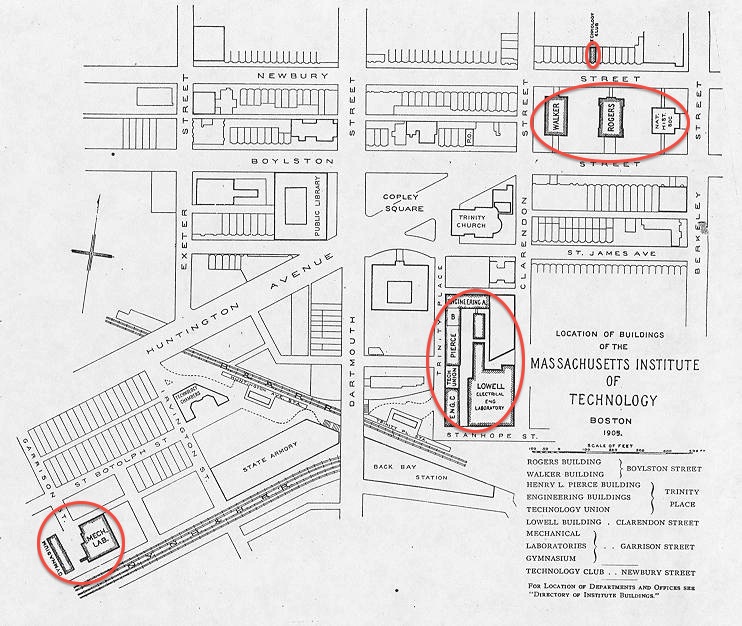
MIT moved to its current Cambridge location in 1916, after marathon legislative wrangling sessions, many discussions and false starts, and much bloviation from faculty, students, and alumni over various possible sites for the institute. Before that, its campus was in the Back Bay, and this map shows the various sites of the institute in 1905--a year that saw MIT almost striking a merger deal with Harvard which would have moved "Boston Tech" to Cambridge to the current site of the Harvard Business School.

Click on the map to see a larger (readable!) version.


1905 map of MIT in Back Bay, Boston

The oval in the upper right shows the main campus buildings. Walker and Rogers were torn down and in their place was constructed the New England Mutual Life Insurance Company Building. The Natural History Museum in the same block still stands, and has served as the location for a number of retail stores over the years; a Restoration Hardware opened there in April, 2013, with a renovation that revealed aspects of the original building that had been covered for years.

The oval in the center of the illustration is now the site of the John Hancock Building.

See my post on Henry Pritchett, president of MIT in 1905, for more information.

Illustration Credits

The map is preserved in MIT's Institute Archives and Special Collections; the author added the ovals.

Tuesday, October 4, 2011

Henry Smith Pritchett

Henry Smith Pritchett
During the first 35 years of its existence, the Massachusetts Institute of Technology was headed by its founder, William Barton Rogers, former Civil War General Francis A. Walker, and two MIT professors.  The selection of Henry Smith Pritchett to become the Institute's fifth president in 1900 signaled a shift in direction.

Pritchett held a doctorate in astronomy from the University of Munich and had demonstrated both his academic and administrative strengths.  He had spent 17 years in academia, and three years in an impressive stint as superintendent of the US Coast and Geodetic Survey where he developed a close relationship with President McKinley.  He was young, bright, energetic, well-connected, handsome, socially adept, and popular, and he arrived at MIT in the summer of 1900 with high hopes for his future there.

Despite his achievements at MIT, Pritchett's career as a college president ended up being a brief six years in duration.  In 1904, Pritchett proposed what was essentially a loose merger between Harvard and MIT.  Under this plan, Harvard's Lawrence Scientific School would become part of the Institute, the Institute would move to Cambridge under the aegis of Harvard (on the site currently occupied by the Harvard Business School), and Pritchett would retain the presidency and a certain amount of independence for the Institute.  MIT alumni and faculty were largely opposed, but the real fly in the ointment was the unwillingness of the Massachusetts legislature to allow the sale of Tech's Boston property on Boylston Street.  Pritchett resigned the presidency of MIT after the deal fell through, and left Boston in 1906 to head the brand new Carnegie Foundation for the Advancement of Teaching.

Pritchett is largely a forgotten man in Boston and Cambridge but his influence on education and educators in this mecca of US education was enormous.

MIT

His first achievement was his work at MIT.  Dr. Robert Payne Bigelow, a professor there from 1893-1933, says that Pritchett's administration was "a turning point in the history of the Institute."

MIT Campus in 1903, Boston
Pritchett’s primary concern was for student welfare—academic, social, and physical.  He encouraged students to seek advice from him, he established a department of physical education, he turned the culture on its head by having top faculty teach freshmen, he cultivated relations with the staff and increased their salaries, he sent professors to visit laboratories abroad, and he developed the departments of chemical engineering and applied electricity.  Bigelow goes on: “I have naturally watched with much interest its growth from the turning point under Pritchett to the magnificent institution it is today.  I have seen practically all of Pritchett’s dreams come true.”

Franklin Union

Pritchett was a great supporter of other forms of industrial education.  In 1904, as a trustee of Boston's Franklin Foundation  (the accumulated value of a thousand pound legacy bequeathed to the city by Benjamin Franklin), he was instrumental in getting Andrew Carnegie to match the $408,000 then in the fund.  This created a large enough endowment to found an evening training school to be called the Franklin Union.  The conditions attached to Carnegie's gift were two:  that the school be similar to the Cooper Union and NYC's Mechanics' and Tradesmen's School, and that the City of Boston provide the land.   Both conidtions were met, and the school opened in its new building in Boston in the fall of 1908.

Today the Franklin Union has become the Benjamin Franklin Institute of Technology, offering nine associate's degrees in engineering and industrial technology, a bachelor's degree in automotive technology, and a variety of certificate programs.

Lowell Institute

During Pritchett's tenure as MIT president, he was asked by Abbott Lawrence Lowell, a Harvard professor (and later to be Harvard president), MIT trustee, and trustee of the Lowell Institute to find a man who could plan and conduct courses aimed at training industrial foremen.  The Lowell Institute had grown out of a bequest by Lowell's grandfather, textile merchant John Lowell, to offer what were to become hugely popular free public lectures to the citizens of Boston.  The new undertaking would be a joint venture by the Lowell Institute and MIT.  Pritchett selected Dr. Charles F. Park to be the director of the Lowell Institute School for Industrial Foremen, a move to which Lowell credited the successful launch of the new school.  Since 1996, the Lowell Institute School has been a part of the Northeastern University College of Professional Studies, offering bachelor's and associate degrees in engineering technologies.

TIAA-CREF

Pritchett's final contribution, this time to educators, was not limited to the Boston area.  As President of the brand new Carnegie Foundation for the Advancement of Teaching, he was charged with developing a plan to provide pensions for retired faculty members.  The Trustees had originally hoped to fund free pensions but it became apparent to them that the endowment was not large enough for this purpose.  Pritchett proposed a pension fund partly funded by the institutions and the faculty members themselves.  This was named the Teachers Insurance and Annuity Association (now better known as part of TIAA-CREF), and Pritchett served as its President from 1918-1930.  (TIAA-CREF today holds over $450 billion in assets.)

NOTE:  The Lowell Institute was also the founder of Boston's public radio/TV station WGBH in 1951.  In 1946, the Institute had begun broadcasting its lectures on the radio, and the Lowell Institute Cooperative Broadcasting Council was the licensee for one of the newly created FM radio channels in April 1951.

Illustration Credits and References

Photo of Henry S. Pritchett from the MIT History website.

1903 photo of the Boylston street MIT campus from Hello Boston History Photo Archive.

Information about Henry Pritchett's career largely obtained from Henry S. Pritchett:  A Biography by Abraham Flexner, New York:  Columbia University Press, 1943.

Wednesday, July 20, 2011

El Jaleo, Isabella Stewart Gardner, and TJ Coolidge

El Jaleo by John Singer Sargent
The painting El Jaleo hangs on the first floor of the Isabella Stewart Gardner museum in a space and setting designed by Isabella to truly showcase this huge (11 feet wide!) and beautiful work by John Singer Sargent. I have admired it numerous times; when I taught at Simmons College (located right across Palace Road from the Gardner) I  frequently ate lunch in the lovely little Gardner cafĂ©, and always stopped for a few moments on my way to lunch to study this painting.

But I just learned today that two of my favorite women from 1905 Boston, Eleonora Randolph Sears and Isabella herself, had a connection through this painting. (Click here to read my previous post about Eleonora.)

Eleo's grandfather, Thomas Jefferson Coolidge, had seen Sargent's talent early on and purchased the painting in 1882, shortly after it was first exhibited by the 26-year-old painter. Isabella, who was a friend (and a cousin by marriage) of Eleo's mother (and TJ's daughter), Nora Coolidge Sears, coveted the painting and tried to buy it from Coolidge for 30 years. According to Eleo biographer Peggy Miller Franck, Coolidge put her off with vague assurances that he would sell it to her one day.

In 1914, most likely worn down after the death of both Nora and her brother in 1912, TJ agreed to loan El Jaleo to ISG for an exhibition she was planning.

Isabella had spent 30 years imagining how to display the painting for maximum effect. In 1914 she directed some major remodeling in Fenway Court (now the Gardner Museum) and constructed a new gallery for the painting, set off by a Moorish stone arch edged with mirrors, and with a display of musical instruments and a row of footlights on the floor in front of the painting. Frank says that when "T.J. saw the showcase that Belle had created, he gave the painting to her."

References

Information from Peggy Miller Franck's Prides Crossing:  The Unbridled Life and Impatient Times of Eleonora Sears, Beverly:  Commonwealth Editions, 2009.

Sunday, January 23, 2011

Massachusetts Issues State License Plates, 1903

Massachusetts was the first state to issue automobile license plates, starting in June 1903.  The plates featured white letters on a cobalt blue background, with the words MASS AUTOMOBILE REGISTER across the top.  They were made of porcelain-covered iron, and were quite small, growing wider as the number of registered vehicles grew larger.

When the law requiring the plates was enacted by the Legislature, the public was given until September, 1903 to comply.  The first plate issued was number "1", to a man named Frederick Tudor.  That number is still an active registration in Massachusetts, held by a member of the Tudor family.

Through 1907, the year of issue was not printed--but unique number ranges were assigned to each year.

For example, in 1905, plates were issued in the range 7,014-11,902.  The middle plate on the first row below, from www.worldlicenseplates.com, is a plate issued in 1905.  In 1908, as can be seen in the third plate in the first row, the year of issue started appearing on the plate.


Prior to the enactment of the new law in 1903, Boston was the only Massachusetts locale requiring automobile registration, and automobile owners had to make their own plates.

Illustration Credits and References

For further information, see the Massachusetts Registry of Motor Vehicles site.  The first license plate illustration in this post appears there as well.

Thursday, October 28, 2010

NECCO, Part 3

In a previous post, I displayed some recent photos of the former NECCO (New England Confectionery Company) factory buildings in the Fort Point Channel area in Boston.  An alert reader who works in the vicinity has made me aware of some wonderful old photos of NECCO and the various other buildings of the Boston Wharf Company (B.W. Co.) in that area.  Thanks Eric!

There are 152 photos in the Boston Wharf Company Collection, and they are housed in the Boston Public Library Print Department.  They were just posted online this month--a good reason for continuing to recheck old sources.

The New England Confectionery Company circa 1907

This photo of the New England Confectionery Company was taken from the bridge slip in Fort Point Channel at the corner of the Summer Street Bridge.  It was taken between 1902-1907, but I'm thinking 1907 is more likely, since it looks like it includes the additional buildings that were constructed in 1907 (after the main building was constructed in 1902).

Click here to see how the building looks today.