Tuesday, November 25, 2008

The French Cable Station


On November 24, 1959, the French Cable Station in Orleans, Massachusetts closed after sending the following message: "Have a happy Thanksgiving. Station closed."

The cable from France to North Eastham, via Newfoundland, had been laid in 1879, and the station then moved to Orleans in 1891. In 1898, a 3,200 mile direct cable ("Le Direct") from France to Orleans was installed. So by 1905, when the photo shown in the above postcard was taken, the French Cable Station was already a fixture on the Cape Cod scene. It later transmitted the news that Lindbergh had landed in Paris in 1927, and that the Germans had taken Paris in 1940. Today it serves as The French Cable Station Museum.

An 1892 Boston Globe article describes the operation of the station:

A good cable operator can keep up a steady pace of 25 words a minute, although of course on occasion and by spurts this rate is often exceeded; yet an operator who can do his 25 a minute is a skilled hand.

The French cable, after plunging into the Atlantic from the Cape Cod shore, makes straight off to sea for the island of St. Pierre, where there is another station, where the messages are repeated to Brest, on the French coast. The fact of the repetition, however, causes no delay worth consideration. . . .

Supposing operators at both ends are sending messages at the rate of 25 words per minute, that is to say, 50 words a minute both ways, each cable would have an hourly capacity of 3000 words, or 30,000 words per hour for the entire 10 - 72,000 for the entire 24 [hours] of each.

When it is understood that all these cables are kept pretty busy night and day, it will be possible to appreciate in a measure what the telegraphic communication between the United States and Europe has grown to be.


Illustration Credits and References

This article from Cape Cod Today describes the history of the station.

Tuesday, October 14, 2008

Wash Day

Just found this photo on Shorpy: History in HD. According to "Shorpy", it's a Currier Photo taken in a laundry circa 1905, possibly in Boston.


The Shorpy site contains an interesting discussion about what's on the ceiling in the photo. I also notice that the woman to the right is standing on a raised wooden platform--probably because the wringing device she's operating (or the process of getting wet laundry out of the sink into the wringing area) generates spilled water on the floor--this might keep her from standing in water, or slipping. Or maybe it just makes her taller?

Sunday, August 31, 2008

Martin Lomasney

Never write if you can speak; never speak if you can nod; never nod if you can wink.
--Martin Lomasney

In 1905, the powerful boss of Boston's West End, Ward 8, was a man named Martin Lomasney.  A native Bostonian, born in 1859 of Irish parents, Lomasney was known in the city as "The Mahatma".

Boston, North Station, 1890s
In her book The Fitzgeralds and the Kennedys, Doris Kearns Goodwin describes him through the eyes of John Francis "Honey Fitz" Fitzgerald, John F. Kennedy's grandfather:

Fitzgerald described this first meeting in vivid detail, recalling the powerful presence Lomasney projected as he sat in his chair surrounded by a half-dozen loyal aides.  A thickset, well-muscled man whose most outstanding feature was a hard rocklike jaw that made him a cartoonist's friend, Lomasney was a bachelor whose entire life was given to the building of his political machine, the Hendricks Club.  He lived a simple, low-key life, renting a small apartment and wearing the same old battered straw hat year round, but to the people of the West End he was a god.  Arriving early each morning at his headquarters, Lomasney worked 365 days a year, caring for "his" people in all phases of their lives.

Lomasney had supported Fitzgerald in his successful campaigns for Massachusetts state senate in 1892 and Congress in 1894.  But when Fitzgerald sought the position of Mayor of Boston in 1905, Lomasney supported another Democrat, Ned Donovan, in the primary.  Fitzgerald beat Donovan for the Democratic nomination, and all the ward bosses, except Lomasney, threw their support behind him in the election.  Lomasney announced that he wouldn't support Fitzgerald, and "his" people voted for Frothingham, the Republican candidate.  (It was the first time in years that Ward 8 had voted for a Republican candidate.)

In spite of the loss of Lomasney's support, Fitzgerald was indeed elected Mayor, a position he would assume on January 1, 1906.

But the story I most love about Lomasney, and the rollicking world of Boston Irish Democratic politics, happened a few years earlier, in 1898.

As told by James J. Connolly in The Triumph of Ethnic Progressivism: Urban Political Culture in Boston, 1900-1925, Lomasney was battling with the Board of Strategy over a seat in the State Senate that represented the West End, along with the North End and part of East Boston.  Lomasney backed Daniel Rourke, one of his Ward 8 supporters, for the seat, while his opponents promoted the candidacy of William J. Donovan of East Boston.  Donovan had received more votes in the caucuses, but Lomasney controlled the nominating convention (which made the formal choice), and hatched a scheme to try and deliver the nomination for his candidate.

With nominations due at the Massachusetts State House in downtown Boston at 5 P.M. on October 20, Lomasney scheduled the convention for 4:30 of the same afternoon and announced that it would be held across Boston Harbor, in an East Boston hotel.  SInce ordinary means of transportation from East Boston to downtown required forty minutes, it was widely suspected that Lomasney planned to use a ferry or another boat to deliver the nomination papers to the State House before the deadline.  Donovan's supporters . . . secretly booked all the available rooms in the hotel and arranged to have men loyal to the Quincy administration manning the ferries running to downtown so they could prevent a Lomasney messenger from reaching the State House.

The result was a competition between the two factions to claim the nomination that involved parliamentary maneuvering as well as races on foot, bicycle, and boat.  Rourke's delegates, led by Lomasney, arrived at the hotel late on the afternoon of October 20, where they assembled in a room Lomasney had surreptitiously booked several weeks earlier.  After tricking Donovan backers into leaving the room, they quickly called the convention to order and nominated Rourke.  Not to be outdone, Donovan's delegates held a separate convention across the hall and selected their own man.  A race to deliver the nominations ensued.  Lomasney dispatched a decoy messenger on a city-run ferry, which was soon stranded in the middle of Boston Harbor, purportedly with engine trouble.  He then sent a sprinter--a Boston College football star--to a private boat that sped across the harbor.  From there, a well-known local bicycle racer pedaled the nomination to the State House, arriving at 4:49 P.M.  In the meantime, Donovan's papers were rushed downtown on a second ferry and handed off to another bicyclist.  But his bicycle chain broke, and he arrived three minutes after Lomasney's messenger. . . . Lomasney's forces claimed victory.

Unfortunately for Lomasney and Rourke, the Ballot Law Commission eventually ruled Donovan the nominee.

Lomasney would go on to be a powerful force in Boston politics until his death in 1933.   And if you come down Causeway Street (where Lomasney's headquarters were), pass North Station, and bear right, you'll find yourself on Lomasney Way for a block or so.  Tip your hat to Martin as you go by--they don't make 'em like that any more!

Illustration Credits and References

The photo at the top of this post is of North Station on Causeway Street in Boston, taken in the 1890s.   It is from the Library of Congress collection.

Saturday, August 9, 2008

Eleonora Randolph Sears

By night (and on selected afternoons), Eleonora Sears was a beautiful and popular young society woman in Boston (and New York), frequently mentioned in the "Table Gossip" column in the 1905 Boston Sunday Globe.

But by day she was a talented, energetic, and daring athlete, playing golf, swimming, riding horses, walking great distances, and winning tennis singles, doubles, and mixed doubles championships in Massachusetts and elsewhere.

Her first appearance in "Table Gossip" in 1905, on January 1, noted her presence at a dinner dance in New York over the Christmas holidays, celebrating the debut of President Roosevelt's niece, Corinne Douglas Robinson. She sat at a table presided over by Miss Eleanor Roosevelt (who would go on to marry Franklin later that year), and, according to the Globe, Miss Sears was "one of the most attractive girls" there.

Eleanora Randolph Sears by Alexander John WhiteEleo had been born in 1881 into a well-to-do Boston family: Thomas Jefferson was her great-great-grandfather and her father was a shipping and real estate tycoon. The Sears lived in a townhouse at 122 Beacon Street, and they were a tennis family. According to the website of the International Tennis Hall of Fame, her father, Frederick Sears, was one of the first to play tennis in the U.S. in 1874, and her uncle, Richard Dudley Sears, was the original U.S. champion (winning the first US open in 1881 and every year thereafter through 1887).

Later in 1905, on a rainy Monday in early June, Eleonora wore white dotted French muslin over white silk and a white hat with pale blue plumes, and carried daisies as a member of the wedding party at the union of Grace Dabney and Robert Wrenn at Nahant.

On August 13, 1905, the Globe reported that she was deferring her visit to Newport as she is “having a very good time in riding, driving, swimming, and tennis with her own friends on the North Shore.” But by August 15, she was playing both singles and doubles at a lawn tennis tournament on the Casino Courts in Newport arranged by Mrs. John Jacob Astor and others. (Mrs. Astor would be divorced from her husband within five years, and therefore would not accompany him on his fatal Titanic journey in 1912.)

By the end of 1905 she was planning a visit to her friend Alice Roosevelt at the White House, and then expected to be off to Europe in early 1906 to visit friends in London.

1914 Rolls Royce Eleanora Sears ownedThe fact that Eleo was on full duty in society, attending the weddings, balls, debuts, and other events that were considered de rigeur for a woman of her day, seemed to give her the license to do what she wanted the rest of the time. She was one of the first women in Boston to learn to drive a car, and was frequently seen driving fast and skillfully around the city. (A 1908 Boston Evening Record tidbit notes that Eleonora Sears and Marie Lee had both "been seen driving through the congested parts of the city with the coolness of experts." Apparently there was some heated discussion among their friends about which of the two was the better driver, and "the champions of Miss Lee wanted to arrange a competition. . . . [T]here may be some wild driving through the city by two very good-looking lovers of the motor shortly.")

Sometime in 1905 or 1906, Eleonora started "being seen with" the young Harold Vanderbilt, heir to the Vanderbilt fortune, who shared many of Eleo's sporting proclivities. (He would go on to take the America's Cup three times in the 1930s.) They denied their engagement for some years (though Eleo's mother announced a "trial engagement" in 1911), and eventually drifted apart.
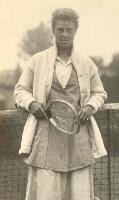
Eleanora Sears, TennisEleo would go on to an incredible career as a sportswoman--the first great multi-sport woman of the 20th century. In 1910, when most of her accomplishments were still to come, she was proclaimed in a magazine article as "the best all-around athlete in American society." She would win 240 trophies in a variety of sports during her career.

Eleo continued to play tennis, winning the US women's doubles title with Hazel Hotckhiss Wightman in 1911 and 1915, and again with Molla Bjurstedt in 1916 and 1917. She was a finalist for the women's singles title in 1912, won mixed doubles with Willis Davis in 1916, and would be inducted into the Tennis Hall of Fame in 1968, shortly after her death.

She also continued to walk! She frequently walked from Boston to Providence, with her best time coming in 1926, when she walked the 47-mile trip in 9 hours and 53 minutes. (My father, who was born in 1920, recalls seeing motion picture images of this walk of Eleonora's on a primitive movie player he had as a child.) During a visit to France she walked 42.5 miles from Fontainebleu to the Ritz Bar in Paris in eight and half hours. She once walked the 73 miles from Newport to Boston in 17 hours.

She continued to swim--a 1908 Globe article reported that she would be “glad to accept the swimming race challenge” of Miss Vera Gilbert, the belle of New York’s 400. She was the first (not just first woman) to swim the four and half miles from Bailey's Beach to First Beach in Newport.

She bred and trained show horses for most of her adult life--and rode horses until she died in 1968. She took up polo (a favorite sport of her male society contemporaries), shockingly riding her horse astride. She was the first woman known to have worn trousers for sporting purposes when in 1909 she appeared on the polo ground of the Burlingame (CA) Country Club in breeches and a cutaway coat and asked to be allowed to participate in a match. She was promptly ordered to leave the field. In 1912, when she was seen frequently around Burlingame in her riding breeches (only on "occasions when I had just returned from riding" she claimed), the "Burlingame Mothers' Club" passed a resolution against her behavior. (While this resolution was posted all around town, Eleonora later found out there was no such organization.) Staying the course, she became the first woman to ride astride at the National Horse Show, in 1915.

She started playing squash in 1918, and in 1928 helped to found the US Women's Squash Racquets Association. She was its first singles champion that same year (at the age of 46), later served as its president, and was captain of the US national team.

She also would participate in baseball, field hockey, and auto racing. She would pilot planes, skipper yachts, and race power boats.

And she would continue to play her role in society. In 1924, when he spent a packed day in Boston hunting by day at Myopia, and dancing by night with the debutantes, Prince Edward, the Prince of Wales (although 13 years her junior) was said to be so charmed by her that he spent much of the evening as her dancing partner. (Edward would of course go on to marry Wallis Simpson, and abdicate the British throne.)

Another male admirer wrote a letter to Time magazine, published on February 22, 1963, which sums up Eleo's dual life:

Sir: I am amazed by the amount of publicity given to the announcement that Attorney General Robert Kennedy and some others managed to walk 50 miles. In December 1925, Miss Eleonora Sears walked from Providence to Boston, a distance of 47.8 miles, in 10 hrs. 20 min.

I know because I walked with her. Miss Sears entertained me for dinner that evening, and I took her to the theater. Miss Sears knows her age better than I do, but she was then in her 40s at least, and could probably outwalk the New Frontiersmen today.

ALBERT P. HINCKLEY, Orlean, Va.


Nothing like a brisk 10 hour walk to get you warmed up for an evening of dining and theatre. Way to go, girl!

Illustration Credits and References

The painting of the young Eleonora (entitled Young Girl in Rose (or Portrait of Eleonora Randoph Sears)) was painted by John White Alexander in 1895 when Eleonora was 13; the image appears on the Art Renewal Center website.

The auto is a current photograph of a 1914 Rolls Royce that was owned and driven by Eleonora (presumably when it was new!)

The photograph of Eleonora with her racquet appears on the Tennis Hall of Fame website.

The information about Eleonora was culled from numerous sources including the Boston Daily Globe, several other regional US newspapers, the Tennis Hall of Fame website, the Hickok Sports website, and many other websites devoted to women and sports.

Monday, August 4, 2008

The Longfellow Bridge


Today's post was prompted by an article in yesterday's Boston Globe about the repairs needed on the 100 plus-year-old Longfellow Bridge.

The bridge (known as the West Boston Bridge until 1927) was designed by the architect Edmund M. Wheelwright, a Boston native and Harvard graduate. Wheelwright had been part of the design team for the Boston Public Library when he worked for McKim, Mead, and White in NYC. He had started his own firm in Boston in 1897 and appears to have begun working on the bridge design quite soon after that, since construction started in 1900.

With excellent forethought, the new bridge was designed and built to support automobile and train traffic, even though the subway system didn’t extend that far at the time it was built, and cars were still exceptions on the roads.

The steel superstructure of the bridge was completed in 1904, and the road across the bridge was paved in 1905, although the grand opening of the bridge was not held until July 31, 1907.

I became interested in the bridge historically because, on the evening before the November 16, 1905 primary for the election of a new Boston mayor, John Francis Fitzgerald (JFK's grandfather), conducted a whirlwind speaking tour of all the wards in the city of Boston (zooming about the city in the rain with his advisors and supporters in a parade of six automobiles). At the first stop of the evening in West Boston (Ward 8), a little after 7 p.m., he spoke with 300 supporters at the intersection of Cambridge and Charles Streets, "at the entrance to the new bridge," reported the Boston Daily Globe on November 16.

Wheelwright's designs would create structures that have become some of the most visible landmarks in modern-day Boston and Cambridge. In addition to the BPL and the Longfellow Bridge, he also designed Horticultural Hall (completed in 1901), Jordan Hall at the New England Conservatory (completed in 1903), and the Harvard Lampoon Building (completed in 1909). (Wheelwright had been a Lampoon member at Harvard.) He was also a consulting architect for the Boston Museum of Fine Arts (completed in 1909).

Sadly, Wheelwright's work was cut short when he suffered a mental breakdown in 1910, which, according to the August 15 New York Times "developed in connection with his work as designer of the Hartford Bridge over the Connecticut River". He died in 1912 at a sanitarium in Connecticut, apparently by his own hand.

Tuesday, July 29, 2008

Kissing in Canoes

Canoeing on the Charles RiverUrban canoeing had become a popular activity in many US cities in the late 19th century. Boston's Charles River became a well-known destination for leisurely trips on the water, since the boathouses in Newton were accessible by train and trolley from all over the city.

One of the most popular of these sites was Norumbega Park which had been built in 1897, a year after the trolley running down Commonwealth Avenue in Newton had been completed. (The Marriott Hotel now stands at this location.) The park offered canoeing, a zoo, a merry-go-round, picnic spots, a restaurant, and a vaudeville theatre, and admission could be had for a nickel (fifteen cents if you bought a package deal including trolley fare). Its boathouses and Pavilion can be seen on the left side of the double postcard image below.

Canoeing at Norumbega 1905
A large recreation area was also built at Riverside (on the Weston side of the river) the same year. The Riverside Recreation Grounds included the obligatory boathouse, the largest swimming pool in New England, a football field, a baseball diamond, a track facility and outdoor gymnasium, tennis courts, bowling alleys, a restaurant, a bandstand, and dormitories.

Both venues fast became popular destinations for huge crowds of families and young adults from all over the area.

In 1903, the Metropolitan Parks Commission, which controlled six miles of the Charles River, from Newton to Waltham, issued new rules of conduct for for the crowd of boaters in that area, forbidding activities such as drinking, gambling, and "any obscene or indecent act." In the two-year period from August 1903 to September 1905, 37 individuals were arrested under these guidelines for kissing or lying down in canoes on this stretch of the river.

The young people fought back almost immediately. Canoeists who went out on the river refused to sit up straight, and young women taunted the police on the riverbanks to take action. Late in the summer of 1903, protesters massed below the superintendent's office which overlooked the river.

They "sprawled out" in disregard of MPC rules and set up phonographs outside the superintendent's office playing, as the Post put in, "jesting songs into his ear." Up and down the river, canoeing couples baited the police, playing love songs, throwing kisses at the officers, and disobeying the sit-up rule. [1]

Local newspapers charged that the problems on the river were all caused by troublemakers from Boston. The former mayor of Waltham surmised that Boston men brought their dates to the river to get them drunk. Yet data shows that, of the 37 individuals arrested between 1903 and 1905, only a third were from Boston--the rest were from the suburbs near the river.

In 1904, the MPC police equipped their station with darkroom equipment (the better to do some fast photo development of miscreants) and started monitoring behavior with binoculars. (You can see the MPC boathouse at Norumbega on the right side of the postcard above.) Boathouse owners in the MPC-controlled area cited a 50% loss of business, as many thwarted lovers rode the trains and trolleys to Dedham, which was not yet under the jurisdiction of the Commission.

In 1905, a new summer canoe house and ballroom was built on the banks of the river in Dedham, probably to take advantage of the boom in Dedham canoeing. Called Moseley's on the Charles, its ballroom is still a popular destination for weddings and banquets.

In her diary for June 5, 1905, Cynthia writes:

Helped wash in the morning. In p.m., went up to Dedham canoeing--Pauline, C. Rason, C.H., & I. "Cherries" on way home; Charlie got them for me.

And again on June 15:

Went canoeing this afternoon; it was just lovely on river. Pauline, Charlie, Lizzie, C.H., & I--took lunch.

1905 turns out to have been the pivotal year of change on this issue of behavior on the river. In September of that year, the MPC suffered its first court defeat on one of these indecent behavior charges, and the number of arrests dropped rapidly after that. In the five subsequent years, only seven couples were arrested.

According to historian Thomas A. McMullin, whose wonderful article in The New England Quarterly was the source of much of the information in this post:

Scholars have traditionally argued that the shift in American romantic mores occurred in the 1920s, but more recent studies have suggested that the changes began earlier, particularly for the working class.

McMullin attributes these changes to the expansion of white-collar work at the turn of the century, the change in perception of what was acceptable behavior among young women (who had started bicycling and pursuing other outdoor activities, in addition to beginning to date rather than being "called upon"), movies--which showed "abundant images of romantic encounters", and the construction of the trolley network.

UPDATE: In January 2018, journalist Crystal Ponti interviewed me and Clara Silverstein, the Community Engagement Manager for Historic Newton, about the "Kissing in Canoes" phenomenon for her Historium Unearthia podcast. You can read more and listen here. Crystal talks about the phenomenon for the first 15 minutes, which is followed by the two interviews (up to about 28:00).

Illustration Credits and References

[1] The quotes above, and much of the other background information in this post, were taken from an article by Thomas A. McMullin in the September, 2000 issue of The New England Quarterly. The article is entitled: "Revolt at Riverside: Victorian Virtue and the Charles River Canoeing Controversy, 1903-1905." McMullin (at least at the time) was an Associate Professor of History at U.Mass. Boston.

The colored postcard at the top of this post is entitled "Canoeing on the Charles River," and it shows a photograph taken in 1905, and probably colorized a few years later. The sepia photo further down is a 1905 double postcard entitled "The Charles River from Weston Bridge, Auburndale, Mass." These postcards are part of a terrific collection of early 20th century postcards of the river that belong to the Newton History Museum.

Friday, July 18, 2008

Caroline Bishop Stanley

Caroline Bishop Stanley was born in 1879 to a Nahant, Massachusetts family that had lived near Boston for generations. Her family was related to many of the well-known Massachusetts families of the period, including the Cabots, Choates, and Perkinses. While the Stanleys weren't wealthy, they were comfortable, and Caroline seemed destined for a prosperous and circumspect Victorian lady's life. She had the leisure to pursue higher education and graduated from Boston's New England Conservatory of Music in 1905.


She was already "old" (by marriageability standards of the time) and still living at home, looking for a job as a music teacher. However, she wouldn't remain in Boston long. During the next few years, she went to Chicago, where she got involved with the social settlement movement. According to author Lesley Poling-Kempes, she:

. . . taught music at the Chicago Kindergarten Institute and began to move in a circle of educated and socially active women. . . . In her late twenties, Stanley joined this league of women who would later be called progressive idealists--educated, motivated women seeking meaningful work that led them out of a boring and useless existence in Victorian America. . . . Music, Stanley's friends believed, was a birthright of all people, and music education a vital part of any person's development and growth.

However, the biggest change in Carol Stanley's life was yet to come. In her mid-30s, she fell in love with a musician in Boston of whom her parents disapproved. She apparently acquiesced to their plans to send her out West to forget him. Most likely, her family thought a year or so away from temptation would be enough, and that she would return to Boston and take up an "appropriate" life.

But Carol never returned to Boston or Chicago (except for some brief visits). She took the train to Santa Fe sometime in 1914,
and with a Chicago friend spent a couple of years riding horses into the remote country in the Four Corners area, camping under the stars, and experiencing a kind of life that was completely foreign to her East Coast upbringing. (It's worth noting that Pancho Villa raided New Mexico in 1916--life was still pretty wild and woolly on the frontier!)

In 1916, Carol was part of a groundbreaking horseback excursion, which, according to Poling-Kempes:

. . . began in mid-September in Santa Fe, and wove across northwestern New Mexico and into the Navajo country of the Colorado Plateau. This particular expedition made headlines because no one had ever attempted to ride horseback to the Indian Country of northern Arizona and southern Utah from Santa Fe.

Near the end of the trip, on October 2, Carol married Richard LeRoy Pfaffle, one of the tour guides (whom she had met for the first time in the spring of 1916). Carol and Roy moved into a guest house at the Ramon Vigil Ranch, a guest ranch about 20 miles from Santa Fe, to act as caretakers. Several years later, they decided to open their own guest ranch, and bought a "crumbling but historically rich and outstandingly beautiful rancho" in Alcalde, NM, near the San Juan Pueblo. They renovated the property, and opened San Gabriel Ranch in 1920.

San Gabriel was a popular destination--the Pfaffles' guests included Rockefellers, Archibald MacLeish, and Willa Cather. Carol taught music at the Pueblo, and in Alcalde, during the winter months. But business was severely hurt by the Depression, and in 1931, after divorcing Roy (who was by this time a seriously ill alcoholic), Carol abandoned San Gabriel to foreclosure, and moved, with her Steinway piano and her Navajo rug collection, to a decrepit homestead outside of Abiquiú, a property that Roy had won in a card game a few years earlier.


Carol called the property Ghost Ranch, and she set about renovating it for another try at the guest ranch business. In the summer of 1934, the woman who was to become most associated with Ghost Ranch, Georgia O'Keeffe, showed up, looking to spend some time in a casita there. Carol had only one room available for one night, and O'Keeffe took it. During the night, another guest became ill, and the family left their casita precipitously. O'Keeffe moved in, "and I never left".

In 1935, Stanley sold the ranch to one of her regular visitors, Arthur Pack, married her foreman, Lloyd Miller, and eventually settled with him in Arboles, Colorado, where Carol worked as the postmistress. She died of a heart attack in 1948, at the age of 67. Poling-Kempes writes:

Although it was a long drive over the high mountains in winter snow, Dorthy Burnham Fredericks remembers that "all the cowboys showed up for her funeral. All of them."

Illustration Credits and References

The photo at the top of this post is of the New England Conservatory in Boston, taken in 1904. It is from the Library of Congress collection.

The Ghost Ranch photo was taken by the author.

Information about Carol Stanley comes from Lesley Poling-Kempes' wonderful book, Ghost Ranch, published by the University of Arizona Press in 2005.