Wednesday, May 21, 2014

Longfellow Bridge Remodeling

An early photo of the Longfellow Bridge.
A recent article in the Boston Globe discussed the remodeling of the Longfellow Bridge in Cambridge, and how all the contractors were having to obtain old materials (like Rockport granite), and learn old building techniques (like riveting), in order to perform a historically accurate job.

The Longfellow Bridge is an architectural gem that was completed in 1905 (although its grand opening was not held until 1907).

Click here to read my previous blog post about the history of this beautiful bridge!

Illustration Credits and References

The photo was found in the Cambridge Civic Journal for April 1, 2013.

Thursday, April 17, 2014

17th Century Boston Street and Place Names

I'm reading King Philip's War: The History and Legacy of America's Forgotten Conflict by Eric B. Schultz and Michael J. Tougias, and discovered some fascinating references to Boston street and place names that have survived from that period.
Tremont Street, 1891.
There were three connected hills in the Boston settlement when the English arrived in 1630; they were named Cotton Hill, Sentry Hill, and West Hill. The three peaks were collectively known as the "Trimount", a name which has survived in the modern street name of the road that gave access to the three hills--Tremont Street.

Cutting Down Beacon Hill.
An order was given in the colony that in times of danger a beacon should be placed atop Sentry Hill (which at the time rose 185 feet above sea level). As a result it eventually became known as Beacon Hill (and Beacon Street the road which led up the hill). Beacon Hill eventually shrank when its soil was used to fill in Mill Pond between 1807-1828.

Cotton Hill and West Hill were also flattened, and today are the locations of Pemberton Square and Louisburg Square respectively.

Deer Island, where the Christian Indians were exiled in the fall of 1675, was so called for the many deer that used it as an escape from wolves on the mainland. (Today, Deer Island is home to the MWRA's sewage treatment plant, and connected by a landfall and road to Winthrop.)

Illustration Credits and References

The photograph of Tremont Street in 1891 was found on Wikimedia Commons.

The illustration entitled "Cutting Down Beacon Hill" was found on Wikimedia Commons. (Note the State House to the right, which was built in 1798.)

For more information, see the post entitled "How Boston Lost Its Hills" on the Massachusetts History site.

Tuesday, December 24, 2013

Copley Square, Boston

"Copley Square, Boston," by Arthur Clifton Goodwin
Here is another Boston street scene by Arthur Clifton Goodwin. (See my previous post just below this one for his information.) This was painted in 1908, but it's close enough to 1905--except that the cars are a little newer!

It is owned by the Museum of Fine Arts in Boston, but is currently out on loan.

The painting conveys a lovely winter spirit, so . . . Merry Christmas, everyone!

Thursday, November 21, 2013

Late November Afternoon

"Late November Afternoon…." by Arthur Clifton Goodwin
This painting offers a lovely glimpse of Boston life on what we are told is a late November afternoon in the Public Garden. It was painted about 1905 by Arthur Clifton Goodwin (1864-1929) who, according to the Pierce Galleries website, "is known primarily for his spontaneously executed impressionistic views of docks, harbors, landscapes, and cityscapes in and around Boston, Gloucester, and New York City."

It belongs to the Boston Museum of Fine Arts, though it is not currently on display.

Sadly, Arthur Goodwin came to an unhappy end. After his marriage failed, he returned to Boston from New York and embarked on a Bohemian lifestyle, drinking heavily. Arthur had never visited Paris but he kept telling people he wanted to go there to see French impressionists' work with his own eyes. After one night of particularly heavy drinking he was found dead in his Boston studio, the unused Paris tickets still in his pocket.

Friday, September 13, 2013

Boston Trolley Ride, 1903

A friend shared this on Facebook recently and I thought it needed to be posted here!


Previously I had posted a film from a 1906 San Francisco trolley ride. In that post, I noted: "It's hard today for us to imagine what city streets were like in 1905. There was an element of lawlessness--and pedestrians, newsboys, bicyclists, trolleys, cars, horses, and wagons/sleds all occupied the streets willy-nilly."

The opening of this film shows traffic on Tremont and Washington Streets, which was one of the most congested areas in the city. (You can clearly see the old Jordan Marsh store.) In 1897, Boston had opened its first subway line, right under Tremont and Washington, to help with the traffic. It's so crowded in the film, it's hard to imagine there were even more trolleys and people there before 1897!

Construction of that first subway tunnel was just like the Big Dig--they built it in the middle of the living city!  Each night, they would dig 12 foot wide strips on Tremont Street, and then cover them and shore them up with timbers.  In the daytime, traffic down Tremont could continue unabated, and the workers could continue with digging and construction underneath.

In 1901, the elevated line from Charlestown to North Station opened--you can see the elevated station (which looked the same for a century!) in the middle of the film.

The final section of the film shows Boylston Street and Copley Square.

A year or so after this film was made, in December of 1904, Boston would open its first under-harbor tunnel, the East Boston trolley tunnel.


Saturday, June 15, 2013

MIT in the Back Bay

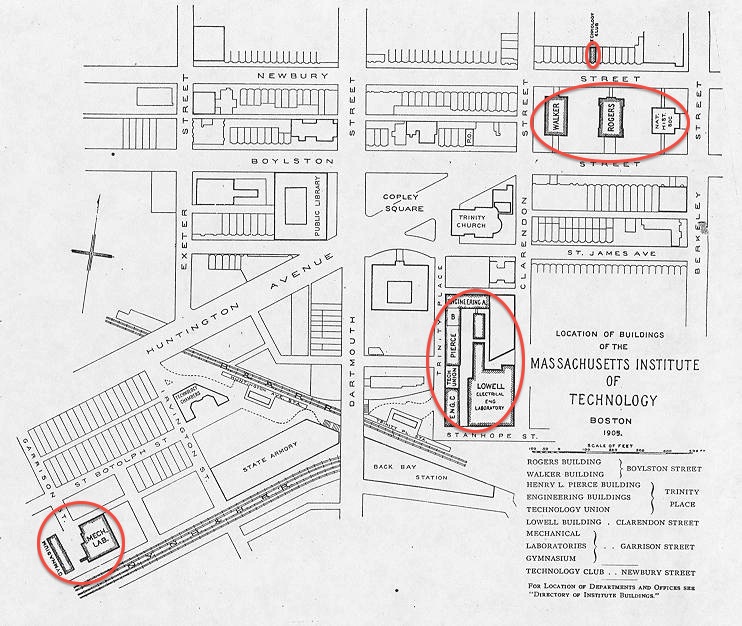
MIT moved to its current Cambridge location in 1916, after marathon legislative wrangling sessions, many discussions and false starts, and much bloviation from faculty, students, and alumni over various possible sites for the institute. Before that, its campus was in the Back Bay, and this map shows the various sites of the institute in 1905--a year that saw MIT almost striking a merger deal with Harvard which would have moved "Boston Tech" to Cambridge to the current site of the Harvard Business School.

Click on the map to see a larger (readable!) version.


1905 map of MIT in Back Bay, Boston

The oval in the upper right shows the main campus buildings. Walker and Rogers were torn down and in their place was constructed the New England Mutual Life Insurance Company Building. The Natural History Museum in the same block still stands, and has served as the location for a number of retail stores over the years; a Restoration Hardware opened there in April, 2013, with a renovation that revealed aspects of the original building that had been covered for years.

The oval in the center of the illustration is now the site of the John Hancock Building.

See my post on Henry Pritchett, president of MIT in 1905, for more information.

Illustration Credits

The map is preserved in MIT's Institute Archives and Special Collections; the author added the ovals.

Tuesday, October 4, 2011

Henry Smith Pritchett

Henry Smith Pritchett
During the first 35 years of its existence, the Massachusetts Institute of Technology was headed by its founder, William Barton Rogers, former Civil War General Francis A. Walker, and two MIT professors.  The selection of Henry Smith Pritchett to become the Institute's fifth president in 1900 signaled a shift in direction.

Pritchett held a doctorate in astronomy from the University of Munich and had demonstrated both his academic and administrative strengths.  He had spent 17 years in academia, and three years in an impressive stint as superintendent of the US Coast and Geodetic Survey where he developed a close relationship with President McKinley.  He was young, bright, energetic, well-connected, handsome, socially adept, and popular, and he arrived at MIT in the summer of 1900 with high hopes for his future there.

Despite his achievements at MIT, Pritchett's career as a college president ended up being a brief six years in duration.  In 1904, Pritchett proposed what was essentially a loose merger between Harvard and MIT.  Under this plan, Harvard's Lawrence Scientific School would become part of the Institute, the Institute would move to Cambridge under the aegis of Harvard (on the site currently occupied by the Harvard Business School), and Pritchett would retain the presidency and a certain amount of independence for the Institute.  MIT alumni and faculty were largely opposed, but the real fly in the ointment was the unwillingness of the Massachusetts legislature to allow the sale of Tech's Boston property on Boylston Street.  Pritchett resigned the presidency of MIT after the deal fell through, and left Boston in 1906 to head the brand new Carnegie Foundation for the Advancement of Teaching.

Pritchett is largely a forgotten man in Boston and Cambridge but his influence on education and educators in this mecca of US education was enormous.

MIT

His first achievement was his work at MIT.  Dr. Robert Payne Bigelow, a professor there from 1893-1933, says that Pritchett's administration was "a turning point in the history of the Institute."

MIT Campus in 1903, Boston
Pritchett’s primary concern was for student welfare—academic, social, and physical.  He encouraged students to seek advice from him, he established a department of physical education, he turned the culture on its head by having top faculty teach freshmen, he cultivated relations with the staff and increased their salaries, he sent professors to visit laboratories abroad, and he developed the departments of chemical engineering and applied electricity.  Bigelow goes on: “I have naturally watched with much interest its growth from the turning point under Pritchett to the magnificent institution it is today.  I have seen practically all of Pritchett’s dreams come true.”

Franklin Union

Pritchett was a great supporter of other forms of industrial education.  In 1904, as a trustee of Boston's Franklin Foundation  (the accumulated value of a thousand pound legacy bequeathed to the city by Benjamin Franklin), he was instrumental in getting Andrew Carnegie to match the $408,000 then in the fund.  This created a large enough endowment to found an evening training school to be called the Franklin Union.  The conditions attached to Carnegie's gift were two:  that the school be similar to the Cooper Union and NYC's Mechanics' and Tradesmen's School, and that the City of Boston provide the land.   Both conidtions were met, and the school opened in its new building in Boston in the fall of 1908.

Today the Franklin Union has become the Benjamin Franklin Institute of Technology, offering nine associate's degrees in engineering and industrial technology, a bachelor's degree in automotive technology, and a variety of certificate programs.

Lowell Institute

During Pritchett's tenure as MIT president, he was asked by Abbott Lawrence Lowell, a Harvard professor (and later to be Harvard president), MIT trustee, and trustee of the Lowell Institute to find a man who could plan and conduct courses aimed at training industrial foremen.  The Lowell Institute had grown out of a bequest by Lowell's grandfather, textile merchant John Lowell, to offer what were to become hugely popular free public lectures to the citizens of Boston.  The new undertaking would be a joint venture by the Lowell Institute and MIT.  Pritchett selected Dr. Charles F. Park to be the director of the Lowell Institute School for Industrial Foremen, a move to which Lowell credited the successful launch of the new school.  Since 1996, the Lowell Institute School has been a part of the Northeastern University College of Professional Studies, offering bachelor's and associate degrees in engineering technologies.

TIAA-CREF

Pritchett's final contribution, this time to educators, was not limited to the Boston area.  As President of the brand new Carnegie Foundation for the Advancement of Teaching, he was charged with developing a plan to provide pensions for retired faculty members.  The Trustees had originally hoped to fund free pensions but it became apparent to them that the endowment was not large enough for this purpose.  Pritchett proposed a pension fund partly funded by the institutions and the faculty members themselves.  This was named the Teachers Insurance and Annuity Association (now better known as part of TIAA-CREF), and Pritchett served as its President from 1918-1930.  (TIAA-CREF today holds over $450 billion in assets.)

NOTE:  The Lowell Institute was also the founder of Boston's public radio/TV station WGBH in 1951.  In 1946, the Institute had begun broadcasting its lectures on the radio, and the Lowell Institute Cooperative Broadcasting Council was the licensee for one of the newly created FM radio channels in April 1951.

Illustration Credits and References

Photo of Henry S. Pritchett from the MIT History website.

1903 photo of the Boylston street MIT campus from Hello Boston History Photo Archive.

Information about Henry Pritchett's career largely obtained from Henry S. Pritchett:  A Biography by Abraham Flexner, New York:  Columbia University Press, 1943.

Wednesday, July 20, 2011

El Jaleo, Isabella Stewart Gardner, and TJ Coolidge

El Jaleo by John Singer Sargent
The painting El Jaleo hangs on the first floor of the Isabella Stewart Gardner museum in a space and setting designed by Isabella to truly showcase this huge (11 feet wide!) and beautiful work by John Singer Sargent. I have admired it numerous times; when I taught at Simmons College (located right across Palace Road from the Gardner) I  frequently ate lunch in the lovely little Gardner café, and always stopped for a few moments on my way to lunch to study this painting.

But I just learned today that two of my favorite women from 1905 Boston, Eleonora Randolph Sears and Isabella herself, had a connection through this painting. (Click here to read my previous post about Eleonora.)

Eleo's grandfather, Thomas Jefferson Coolidge, had seen Sargent's talent early on and purchased the painting in 1882, shortly after it was first exhibited by the 26-year-old painter. Isabella, who was a friend (and a cousin by marriage) of Eleo's mother (and TJ's daughter), Nora Coolidge Sears, coveted the painting and tried to buy it from Coolidge for 30 years. According to Eleo biographer Peggy Miller Franck, Coolidge put her off with vague assurances that he would sell it to her one day.

In 1914, most likely worn down after the death of both Nora and her brother in 1912, TJ agreed to loan El Jaleo to ISG for an exhibition she was planning.

Isabella had spent 30 years imagining how to display the painting for maximum effect. In 1914 she directed some major remodeling in Fenway Court (now the Gardner Museum) and constructed a new gallery for the painting, set off by a Moorish stone arch edged with mirrors, and with a display of musical instruments and a row of footlights on the floor in front of the painting. Frank says that when "T.J. saw the showcase that Belle had created, he gave the painting to her."

References

Information from Peggy Miller Franck's Prides Crossing:  The Unbridled Life and Impatient Times of Eleonora Sears, Beverly:  Commonwealth Editions, 2009.

Sunday, January 23, 2011

Massachusetts Issues State License Plates, 1903

Massachusetts was the first state to issue automobile license plates, starting in June 1903.  The plates featured white letters on a cobalt blue background, with the words MASS AUTOMOBILE REGISTER across the top.  They were made of porcelain-covered iron, and were quite small, growing wider as the number of registered vehicles grew larger.

When the law requiring the plates was enacted by the Legislature, the public was given until September, 1903 to comply.  The first plate issued was number "1", to a man named Frederick Tudor.  That number is still an active registration in Massachusetts, held by a member of the Tudor family.

Through 1907, the year of issue was not printed--but unique number ranges were assigned to each year.

For example, in 1905, plates were issued in the range 7,014-11,902.  The middle plate on the first row below, from www.worldlicenseplates.com, is a plate issued in 1905.  In 1908, as can be seen in the third plate in the first row, the year of issue started appearing on the plate.


Prior to the enactment of the new law in 1903, Boston was the only Massachusetts locale requiring automobile registration, and automobile owners had to make their own plates.

Illustration Credits and References

For further information, see the Massachusetts Registry of Motor Vehicles site.  The first license plate illustration in this post appears there as well.

Thursday, October 28, 2010

NECCO, Part 3

In a previous post, I displayed some recent photos of the former NECCO (New England Confectionery Company) factory buildings in the Fort Point Channel area in Boston.  An alert reader who works in the vicinity has made me aware of some wonderful old photos of NECCO and the various other buildings of the Boston Wharf Company (B.W. Co.) in that area.  Thanks Eric!

There are 152 photos in the Boston Wharf Company Collection, and they are housed in the Boston Public Library Print Department.  They were just posted online this month--a good reason for continuing to recheck old sources.

The New England Confectionery Company circa 1907

This photo of the New England Confectionery Company was taken from the bridge slip in Fort Point Channel at the corner of the Summer Street Bridge.  It was taken between 1902-1907, but I'm thinking 1907 is more likely, since it looks like it includes the additional buildings that were constructed in 1907 (after the main building was constructed in 1902).

Click here to see how the building looks today.

Saturday, August 21, 2010

Saving Boston Common

Boston streetcar traffic, Tremont Street, 1895
It's easy to look at the huge, green expanse of the Boston Common in the middle of Boston and imagine that it was always obvious that it would remain pristine and untrammeled.  But in the late 19th century, the Common came close to being pillaged to support an improved transportation system in the city.

Public transportation in Boston in the 1880s consisted of a number of competing horsecar companies, which ran horse-drawn conveyances over rails through the city streets.  The system was fragmented, and often competing horsecar lines laid parallel tracks next to each other in the congested city.  The  speed of the horsecars was about 5 mph, which limited the maximum commuting distance from the city center to about 4 miles.

There was a clear desire to speed up transit and reduce congestion but it was not clear how that was going to happen.  Cable systems were being built in San Francisco and elsewhere--but cable could not easily be adapted to Boston's topography:   winding, crooked streets, the incursions of the river and the sea, and the looming Beacon Hill.

Electric car lines installed in Richmond, Virginia in 1887-1888 seemed more promising, but it was too expensive for multiple competing horsecar companies to take on.

Eventually, an entrepreneur by the name of Henry Melville Whitney acquired 5 million square feet of land along Beacon Street in Boston and Brookline, with a plan to build housing and a street rail line along the boulevard from Brookline to the center of the city.  When the existing horsecar firms did not demonstrate interest, he engineered a buyout of all their stock, and the West End Street Railway Company came into existence.

At the time of the acquisition in 1887, West End owned 8,400 horses, and 200 miles of track.  By 1892, two-thirds of their track had been converted to electric operations, and by 1894, 90%.  Boston had faster, cheaper, and better public transportation than any other US city.

But West End was a victim of its own success.  Increased travel speed was followed by further city population growth and expansion of the city to the "streetcar suburbs" in Dorchester and elsewhere.  There was pressure on West End to add so-called "rapid transit" to its system--either by subway or elevated line.  Whitney actually won a charter for an elevated line--but study convinced him that it was not suited to the inner city.

A city Rapid Transit Commission (which included Congressman John Fitzgerald, later Mayor of Boston) was formed in 1892.  They held 51 public hearings and traveled to the major European cities with rapid transit systems.  Fitzgerald didn't like the "buried-alive" feeling of being in the London tube, though he was more impressed with the "cut and cover" subways that were very close to the surface.  The RTC made a series of recommendations which included a subway under Boston Common to reduce the major congestion on Tremont and Washington Streets.

Painting by Childe Hassam, Boston Common at Twilight
City dwellers had a significant emotional attachment to the Common, but the growing suburban population of 1893, frustrated by transportation delays, pressed for several alternative solutions:  widening Tremont Street by chopping off the end of the Common, adding an elevated line along the edge of the Common, or laying tracks directly across the Common itself.

West End's proposal wasn't much better--building a subway under the Common but seizing 4 acres for a switching yard and station, cutting down 100 trees, covering the entire subway area with cement or brick, and building 330 ventilation holes, each surrounded by an iron fence 19 feet in circumference!

There was a huge uproar from Bostonians led by the Boston Evening Transcript, and including Julia Ward Howe as a key protestor.  The Transcript said it would be like subdividing Bunker Hill into housing lots.

In 1894, the legislature held hearings and prepared an act (that would be approved by voters in a referendum later that year) that would authorize the city to build subway lines under Tremont and Washington Streets,  a transit bridge to Charlestown, and a transit tunnel under the East Boston harbor.  A private firm would also be authorized to build an elevated line from Charlestown to Roxbury.

The trolleys coming into the inner city would enter the tunnel instead of tying up narrow Tremont Street with tracks and congestion.  And construction of that first subway tunnel was just like the Big Dig--they built it in the middle of the living city!  Each night, they would dig 12 foot wide strips on Tremont Street, and then cover them and shore them up with timbers.  In the daytime, traffic down Tremont could continue unabated, and the workers could continue with digging and construction underneath.

Boston streetcar entering Park Station 1897
Amazingly enough, the project was brought in on-time (opening in 1897 and wrapping up construction in 1898) and under budget.  The city retained ownership of the line, and West End (which became Boston Elevated Railway Company in 1897) leased the right to operate the electric trains through the subway.   In that first year, Park Street Station became one of the busiest railroad stations in the world--serving 40 million passengers in its first eleven months of operation.

Boston thus became the first city in the U.S. to implement a policy of public ownership of rapid transit lines.  The relationship with the private monopoly to operate the trains continued until the 1920s, when rising costs and growing competition from automobiles resulted in losses for Boston Elevated and the city took over operations.

NOTE:  The remaining provisions from the 1894 act were quickly completed--the bridge to Charlestown opened in 1899, the elevated electric line from Charlestown to North Station opened in 1901,  and the East Boston transit tunnel under the harbor opened at the end of 1904.

 Illustration Credits and References

The two photographs in this post were found on the website of "Perfessor" Bill Edwards, Ragtime Era Nostalgia.  The first shows streetcar traffic on Tremont Street in 1895, and the second shows an open streetcar entering Park Street Station via the new tunnel in 1897.

The painting by Childe Hassam, Boston Common at Twilight, shows both the beautiful Common and the streetcars lined up on Tremont Street, and was painted in 1885-86.  Hassam's studio was here on Tremont Street.

Information about the history of Boston's public transportation comes primarily from Charles W. Cheape's Moving the Masses:  Urban Public Transit in New York, Boston, and Philadelphia, 1880-1912.  Cambridge:  Harvard University Press, 1980.

Monday, August 9, 2010

Predictions from 1900

Telephone operator circa 1900
In the December, 1900 issue of the Ladies' Home Journal, engineer John Elfreth Watkins, Jr. made 29 predictions for the next 100 years.  Some seem silly or shortsighted.  (Air travel is only seen as a military action, for example.)  But here are a few that were right on target.

Prediction #4:  There Will Be No Street Cars in Our Large Cities. All hurry traffic will be below or high above ground when brought within city limits. In most cities it will be confined to broad subways or tunnels, well lighted and well ventilated, or to high trestles with “moving-sidewalk” stairways leading to the top.

Prediction #6:  Automobiles will be cheaper than horses are today. Farmers will own automobile hay-wagons, automobile truck-wagons, plows, harrows and hay-rakes. A one-pound motor in one of these vehicles will do the work of a pair of horses or more. Children will ride in automobile sleighs in winter. Automobiles will have been substituted for every horse vehicle now known. There will be, as already exist today, automobile hearses, automobile police patrols, automobile ambulances, automobile street sweepers. The horse in harness will be as scarce, if, indeed, not even scarcer, then as the yoked ox is today.

Prediction #8:  Aerial War-Ships and Forts on Wheels. Giant guns will shoot twenty-five miles or more, and will hurl anywhere within such a radius shells exploding and destroying whole cities. Such guns will be armed by aid of compasses when used on land or sea, and telescopes when directed from great heights. Fleets of air-ships, hiding themselves with dense, smoky mists, thrown off by themselves as they move, will float over cities, fortifications, camps or fleets. . . . Huge forts on wheels will dash across open spaces at the speed of express trains of to-day. They will make what are now known as cavalry charges. . . . Rifles will use silent cartridges. Submarine boats submerged for days will be capable of wiping a whole navy off the face of the deep. Balloons and flying machines will carry telescopes of one-hundred-mile vision with camera attachments, photographing an enemy within that radius. These photographs as distinct and large as if taken from across the street, will be lowered to the commanding officer in charge of troops below.

Prediction #9:  Photographs will be telegraphed from any distance. If there be a battle in China a hundred years hence snapshots of its most striking events will be published in the newspapers an hour later. Even to-day photographs are being telegraphed over short distances.  Photographs will reproduce all of Nature’s colors.

Prediction #10:  Man will See Around the World. Persons and things of all kinds will be brought within focus of cameras connected electrically with screens at opposite ends of circuits, thousands of miles at a span. American audiences in their theatres will view upon huge curtains before them the coronations of kings in Europe or the progress of battles in the Orient. The instrument bringing these distant scenes to the very doors of people will be connected with a giant telephone apparatus transmitting each incidental sound in its appropriate place. Thus the guns of a distant battle will be heard to boom when seen to blaze, and thus the lips of a remote actor or singer will be heard to utter words or music when seen to move.

Prediction #18: Telephones Around the World. Wireless telephone and telegraph circuits will span the world. A husband in the middle of the Atlantic will be able to converse with his wife sitting in her boudoir in Chicago. We will be able to telephone to China quite as readily as we now talk from New York to Brooklyn. By an automatic signal they will connect with any circuit in their locality without the intervention of a “hello girl”.

Prediction #21: Hot and Cold Air from Spigots. Hot or cold air will be turned on from spigots to regulate the temperature of a house as we now turn on hot or cold water from spigots to regulate the temperature of the bath.

Illustration Credits and References

The illustration at the top of this post is of a telephone operator ca. 1900, from Encyclopedia Britannica

Watkins' predictions can be found in full here.

Wednesday, August 4, 2010

Mad Men of an Earlier Era

1905 ad for Colgate's Violet TalcIf you're a Mad Man watcher, you'll know that we don't get a lot of the back story of Sterling Cooper's founders.  But assuming that Bert Cooper (played by 79 year old Robert Morse) is about 75, that means he was born about 1890, and graduated from college about 1911. This was just in time for him to go and work in the fledgling advertising industry.  Although the J. Walter Thompson agency had been founded near the end of the Civil War, what we think of as modern advertising really got its start in the early years of the century.

Prior to the late 19th century, advertising was largely a means for delivering information.  Printing companies often did the design and layout, and many ads used only words.  But in the 1900s, a number of forces came together to result in the development of modern advertising.

  • Rapid growth in technology spawned new printing techniques and new manufacturing techniques.  
  • The growth of mass-marketed consumer products was breathtaking, and companies needed a way to get their message out.  
  • The population of the country was growing at a rapid clip, and there were thousands of magazines and thousands of newspapers to carry the messages.
  • A real middle class was emerging.
The first true consumer culture in the U.S. was birthed in the 1900s.  Because products were being developed so rapidly, advertising was often used to raise awareness of the category.  For example, Colgate promoted the idea of regular toothbrushing, Gillette of daily shaving, and Kodak the concept that everyone should document his/her life.

Technology was also changing packaging--both in the type (the wax-sealed carton or wax wrap for crackers that we still see today in the Ritz box) and in the use of packaging to provide brightly colored brand recognition.

Department stores had developed in US cities in the latter half of the 19th century, but by the 1900s they were adding features that you would still recognize if you grew up in the fifties--soda fountains, lunchrooms, beauty salons, and spacious women's restrooms (with real space for resting!), and advertising promoted all of these features.

In the 1900s, copywriters, artists, designers, and account executives became part of every ad agency's mix.

Advertising and retailing techniques were introduced that are still in use--an enormous customer database at Sears (maintained on index cards and used to segment customers for mailings), advertising jingles, coordinated national campaigns, familiar characters, four-color graphics, advertising in local newspapers, fixed pricing, clearance sales, gift with purchase, pretty girls handing out samples, and even the investigation of fraudulent advertising.

Illustration Credits and References

The ad at the top of this post consumed the entire back cover of the August 1905 issue of The Redbook Magazine.  (Author's collection.)  It appears in four-color print and features a new package for Colgate's Violet Talc and a key benefit for the woman who buys it:  "the new sifter cannot injure soft hands and manicured fingernails, as do the old-fashioned boxes."

The second ad, also from the author's collection, was on the back cover of the June 8, 1905 issue of Life Magazine. While it is not as colorful as the previous ad, the emphasis on filtering and aging, and the well-known tagline, are both techniques visible in beer advertising today.

Information in this post about advertising comes primarily from Bob Batchelor's The 1900s, part of the American Popular Culture Through History series (Greenwood Press, 2002).


Tuesday, July 27, 2010

The Berkeley Building

The Berkeley at 420 Boylston Street
The Berkeley at 420 Boylston Street, designed by the firm of Codman and Despradelle,  is a lyrically beautiful building that was completed in 1905.  Désiré Despradelle was a professor of architecture at MIT who had been educated at the Ecole des Beaux Arts in Paris--an architectural school that was highly influential on early 20th century U.S. architecture.   Boston lagged behind Chicago and New York in construction of the new steel-framed buildings (especially skyscrapers), and this building doesn't compete on height, but its exterior is stunning--its steel frame ornamented with glazed terra-cotta, copper, and glass.

Désiré Despradelle, architectDespradelle taught at MIT from 1893 until his untimely death in 1912, and his students would go on to teach and practice architecture across the country in the years that followed.  Guy Lowell, a former student of Despradelle's (and also an MIT instructor), would design the new Boston Museum of Fine Arts building--completed in 1909.

Despradelle also designed the Peter Bent Brigham Hospital in Boston which opened after his death.

Illustration Credits and References

The photograph of The Berkeley Building appears on blog.petaflop.de

The photograph of Desiré Despradelle was found at the MIT Museum website, which also provided information on Despradelle's career.

Monday, May 31, 2010

Mean Streets

One of the reasons 1905 interests me is that it represents a collision year between old 19th century life and the new 20th century world. On February 2, 1905, the symbolic met the real in Boston when an automobile, a trolley, and a sled full of lumber drawn by four horses collided near the intersection of Dorchester Avenue and Center Street in the winter dusk.

The trolley struck the car and threw it against the sled. The driver of the sled, which had been stuck at the side of the road, was "shaken up." I guess!

Amazingly enough, although the car was totalled (including losing all of its wheels), its occupants sustained only cuts to their faces and hands. As the Boston Globe reports:

The wreckage was cleared away with apprehension by the passengers of the electric car [the trolley], it being feared that one or more of the occupants of the auto had been killed. They arose without assistance, however, and were able to proceed to their homes.

The owner of the vehicle was a Dr. F. L. Purdy of 86 Vernon Street, Brookline, who was riding with his wife in the chauffeur-driven vehicle. Dr. Purdy seems to have been living under a black cloud during this period--his house had burned in 1904 and he lost several valuable paintings in the fire. And about a month before his February 2 accident, the same house had been burgled.

It's hard today for us to imagine what city streets were like in 1905. There was an element of lawlessness--and pedestrians, newsboys, bicyclists, trolleys, cars, horses, and wagons/sleds all occupied the streets willy-nilly. The film below, shot in San Francisco a few days before the 1906 earthquake, makes it apparent that this kind of accident must have happened often--especially on a winter evening!!

Tuesday, January 26, 2010

Grandfather's Clock

1905 grandfather clock by Waltham Clock CompanyGrandfather clocks are so-called because of an 1876 song by American songwriter Henry Work which opens: "My grandfather's clock was too tall for the shelf, so it stood 90 years on the floor."

I am very fond of that song, because my Dad used to sing it to me (and with me) when I was a little girl.

Thanks to history writer Rick Beyer who recently blogged on this story, which is part of his forthcoming book on The Greatest Music Stories Never Told. Here is a 1905 recording of the song by the Edison Male Quartet which Rick unearthed at UCSD's Cylinder Preservation and Digitization Project.

The grandfather clock to the left was made in 1905 by the Waltham (MA) Clock Company; photo is from the Antique Clocks Guy website.

Saturday, November 21, 2009

Honey Fitz Runs for Mayor

John Fitzgerald Campaign Photo 1905John F. Kennedy's grandfather, John F. "Honey Fitz" Fitzgerald, ran for mayor of the city of Boston in 1905. The special election had been precipitated by the sudden death of Mayor Patrick Collins in September. Fitzgerald won the Democratic primary eight weeks later, and then defeated his opponent, the highly respected speaker of the Massachusetts House of Representatives, Louis Frothingham, in the general election.

This cardboard photograph with his campaign slogan at the bottom, "The People not the Bosses Should Rule," was handed out to voters during the campaign.

One of the new campaigning techniques used by Fitzgerald was the motorcade. The Boston Globe describes the night before the primary when Fitzgerald and his retinue zoomed about the city in the rain in a parade of six automobiles. They stopped in each of the city's 25 wards for the energetic Fitzgerald to say a few words, often to huge crowds.

Fitzgerald won the primary against the candidate of the ward bosses, Ned Donovan. Ned was a close friend of ward boss Martin Lomasney, and when Donovan lost the primary, Lomasney refused to support Fitzgerald in the general election.

On the night before the election, Lomasney called his followers to a meeting where he announced: "I'm not going to lay down and be with the gang that has done such a job on us. Now I am going the put the lights out for two minutes. I haven't had time to check up to see who is here and who is not. If anybody here doesn't want to go through with me, just slide out in the dark and there'll be no hard feelings." Lomasney put out the lights, and two minutes later not a soul had moved. On election day, Lomasney's ward supported Frothingham--the first time it had voted Republican in recent memory.

NOTE: For more information on Martin Lomasney, click here to read my earlier post.

Illustration Credits and References

The campaign photo is part of the collection at the JFK Library in Boston.

The story of Lomasney's election eve speech is recounted in Doris Kearns Goodwin's The Fitzgeralds and the Kennedys (New York: Simon & Schuster, 1987).

Sunday, November 15, 2009

A Phone in Every Room!

Castle Square Hotel, Boston 1905
Here is an ad from a January, 1905 edition of the Boston Globe, touting the features of the 500-room Castle Square Hotel, at the time the largest hotel in the city.

$1 a day for singles with shared bath, $2 a day for a double with a private bath, and $3 a day for a suite. And. . . a combination house and long distance phone in every room! (I was actually surprised there were fully telecommunicating hotels this early.....)

Monday, November 9, 2009

Mary Ware Dennett

Mary Ware DennettWomen artists in 1905 were often on the forefront of movements for social change. Mary Ware Dennett used her own personal experiences as an artist, wife, and mother, to advocate for sex education and birth control at a time when such support was considered extremely controversial.

Mary Ware was born in Worcester, Massachusetts in 1874, and moved with her family to Boston after the death of her father. She attended the school of the Boston Museum of Fine Arts from 1891-1893, and took a position as head of the Department of Design and Decoration at the Drexel Institute of Art, Science, and Industry (now Drexel University) when she was 20. After three years there, she and her sister Clara went to Europe to travel and study. They acquired some samples of Cordovan leather hangings, and revived the craft, teaching themselves how to make these pieces. On their return to Boston, they opened a handicrafts store, which later came part of the Boston Society of Arts and Crafts which Mary helped found. Mary continued to serve as the Artistic Director for the shop.

Mary's goal for the SAC was to help garner financial independence for arts and crafts workers. But the board of the SAC was more interested in guiding consumer tastes, and insisted on taking a commission from the artists who sold their work at the store; this made it difficult for them to make a profit.

In January, 1905, Mary would resign from the Society's Governing Council in protest. (Of course, there are two sides to every story, and the Society apparently needed the money. 1905 also marked the year that sales in the store were large enough, at $37,000, to permit the Society to achieve its own financial independence.)

In 1900, Mary married Hartley Dennett, a Boston architect. They seemed to have an ideal partnership--Mary was an established professional at the time of her marriage, and she and Hartley worked together at first--she focused on the interior decoration of the houses her husband designed. But Mary found herself derailed by pregnancy, bearing three children in the first five years of her marriage, one of whom died as an infant. All three deliveries were difficult, and they took a toll on her health. After the birth of her third child in 1905, she suffered serious internal injuries and her doctors advised her to have no more children. But birth control was never discussed. The Dennetts, both in their early 30s, were educated, well-traveled, and progressive. But Mary later wrote: "I was utterly ignorant of the control of conception, as was my husband also. We had never had anything like normal relations, having approximated almost complete abstinence in the endeavor to space our babies."

Mary felt that the only alternative was to give up sex. Hartley was not about to follow suit, and in 1907, whhile Mary was in New York having surgery to repair the damage suffered after her last child, Hartley had an affair with one of his architectural clients.

When Mary discovered this, she determined to end the marriage, and was able to win custody of her two sons in 1909. The Dennetts were granted a divorce in 1913.

Mary had become involved with the woman suffrage movement in 1908, and in 1910 she took a job with the National American Woman Suffrage Association (NAWSA) and moved to New York City. After resigning from NAWSA in 1915, she joined Jessie Ashley and Clara Gruening Williams in founding the National Birth Control League (which would become the Voluntary Parenthood League in 1919).

Also in 1915, Mary wrote a pamphlet for her adolescent sons entitled "The Sex Side of Life". It explained reproduction in no-nonsense terms, and represented sex as a vital and joyous part of life. After privately distributing copies to friends and acquaintances for several years she published the pamphlet in 1918. Throughout the 1920s it was widely distributed to individuals, youth and church organizations, and state health departments.

In 1922, the Solicitor of the Post Office banned the pamphlet as obscene, and Mary Ware Dennett was put on trial in 1928 under the Comstock Law. (This refers to a law enacted by Congress in 1873, An Act for the Suppression of Trade in, and Circulation of, Obscene Literature and Articles of Immoral Use. Anthony Comstock was the head of the New York Society for the Suppression of Vice, an organization financed by wealthy and influential New Yorkers. He and his organization lobbied hard for the bill, and, after it was enacted into law, Comstock was appointed special agent of the U.S. Post Office and charged with enforcing it, a position he held for 42 years.)

Mary was convicted and fined, but appealed the decision with the backing of the ACLU.

Two years later, the US Circuit Court of Appeals held that the Comstock Law "must not be assumed to have been designed to interfere with serious instruction regarding sex matters." The Dennett case was part of a series of decisions that culminated in a 1936 ruling in United States v. One Package of Japanese Pessaries. This decision removed all federal bans on birth control materials and information as tools for medical professionals. However, contraception per se was not removed from the prohibitions of the Comstock Law until 1971.

Interestingly enough, the Comstock Law gave rise to George Bernard Shaw's coinage of the word "comstockery" in 1905, when Comstock attacked Shaw's play, Mrs. Warren's Profession, as "one of Bernard Shaw's filthy productions" by "this Irish smut dealer." In a letter to the New York Times on September 26, 1905, Shaw responded: "Comstockery is the world's standing joke at the expense of the United States."

George Bernard Shaw, Comstockery

Illustration Credits and References

Photo of Mary Ware Dennett from album page in the Carrie Chapman Catt Albums, part of the Carrie Chapman Catt Papers at Bryn Mawr College Library Special Collections, album 5, “New York State and N.Y. City.”

Other sources for this article included:

Harvard University, Arthur and Elizabeth Schlesinger Library on the History of Women in America. Dennett, Mary Ware, 1872-1947. Papers, 1874-1944: A Finding Aid.

"Powders, Pills, Pessaries, Pamphlets, and the Post Office: The Struggle for Access to Sex Education and Birth Control," News From the Schlesinger Library, Spring 2009.

Christen, Richard S., "Julia Hoffman and the Arts and Crafts Society of Portland: An Aesthetic Response to Industrialization," Oregon Historical Quarterly, Volume 109, No. 4, Winter 2008.

Rengel, Marian, Encyclopedia of Birth Control, Santa Barbara: Greenwood Press, 2000.

Sunday, September 20, 2009

NECCO, Part 2

In my last post, I talked about the old NECCO factory that was built in 1902 in the Fort Point Channel area in Boston. On September 13, I was in Boston and went exploring with Dave to find the factory (and also to look for the Gillette factory which began operation in 1905).

I knew the factory was somewhere near the intersection of Summer and Melcher Streets, and right behind Melcher are two streets called Necco St. and Necco Ct. We located buildings on three of the four corners of that intersection that looked like the right era. We walked around, took pictures, and left. In the car on our way to find a bathroom and get something to eat, I was trolling the internet on my iPhone (something I seem to do pretty regularly these days!) and found a December 2008 document from the City of Boston entitled "The Fort Point Channel Landmark District Study Report." One of the many exciting facts contained in that report was a detailed description of the architecture of the Necco building, and its street address (253 Summer and 11-37 Melcher). Necco Factory, Boston, Built 1902 It turns out that the original factory building was a gorgeous, curving yellow brick building on Melcher that we had seen on our visit, but immediately rejected as being too elegant for a factory. Who knew? The buildings immediately behind it (which we had guessed were part of the Necco complex on our first visit, located as they were on 5 and 6 Necco Court) were also built for Necco, and connected to each other and to the main building by the four-storey green connectors you see in the photos below. However they were not there in 1905--they were constructed in 1907.
Back of Necco Factory, Built 1902
Note that the back of the Melcher Street building (which you can see at the right in the above photos) is red brick with smaller windows--not as fancy as the front! None of the buildings is identified with any kind of signage (at least that we could see) to indicate that this was the site of the former Necco factory. And to further complicate the issue, many of the buildings bore a sign identifying the year of construction and a B.W.Co. logo. The photos below are of the sign on the building that turned out to be the 1902 Necco factory.

Boston Wharf Co. Sign on Necco Factory

Boston Wharf Company sign on Necco Factory

It was actually the B.W.Co. sign that led me to the research that led me to the report that led us back to the right building. It turns out that the Boston Wharf Co. was a huge commercial development operation that built most of the buildings in the Fort Point Channel District.

According to the report:

The Fort Point Channel Landmark District (FPCLD) encompasses roughly 55 acres across the Fort Point Channel from downtown Boston. This area, including the land, was entirely developed by a single corporation. . . .The Boston Wharf Company initially specialized in the storage of sugar and molasses, and gradually expanded its interests to become a major developer of industrial and warehouse properties served by ships docking in Boston Harbor, and by the railroad. The Boston Wharf Company laid out and constructed streets which they named for company officers and prominent tenants, parceled out lots, and erected nearly all of the buildings in the FPCLD from the designs of their own staff architects.

Necco Factory and Fort Point ChannelThe last photo in this post is a shot of the Necco factory taken from the Summer Street bridge. It shows the side of the Necco building and Fort Point Channel itself, and you can see the Gillette factory site just behind the smokestack on the right side of the photo. (Gillette is still there today--having surrounded what I think is their original 1906 factory with many additional buildings over the years.)

Necco and Gillette took advantage of their location on the water, and right near the brand new South Station railyard, to ship their products nationally and internationally.

The American Sugar Refining Co. also built a plant in the Fort Point Channel area in 1902 to manufacture Domino sugar. Probably not a coincidence that Necco was located hard by the sugar factory!

Today the Boston HarborWalk runs through the basement of the old Necco building, connecting the waterfront along the more inland part of the channel with the area around the Courthouse Plaza and beyond.